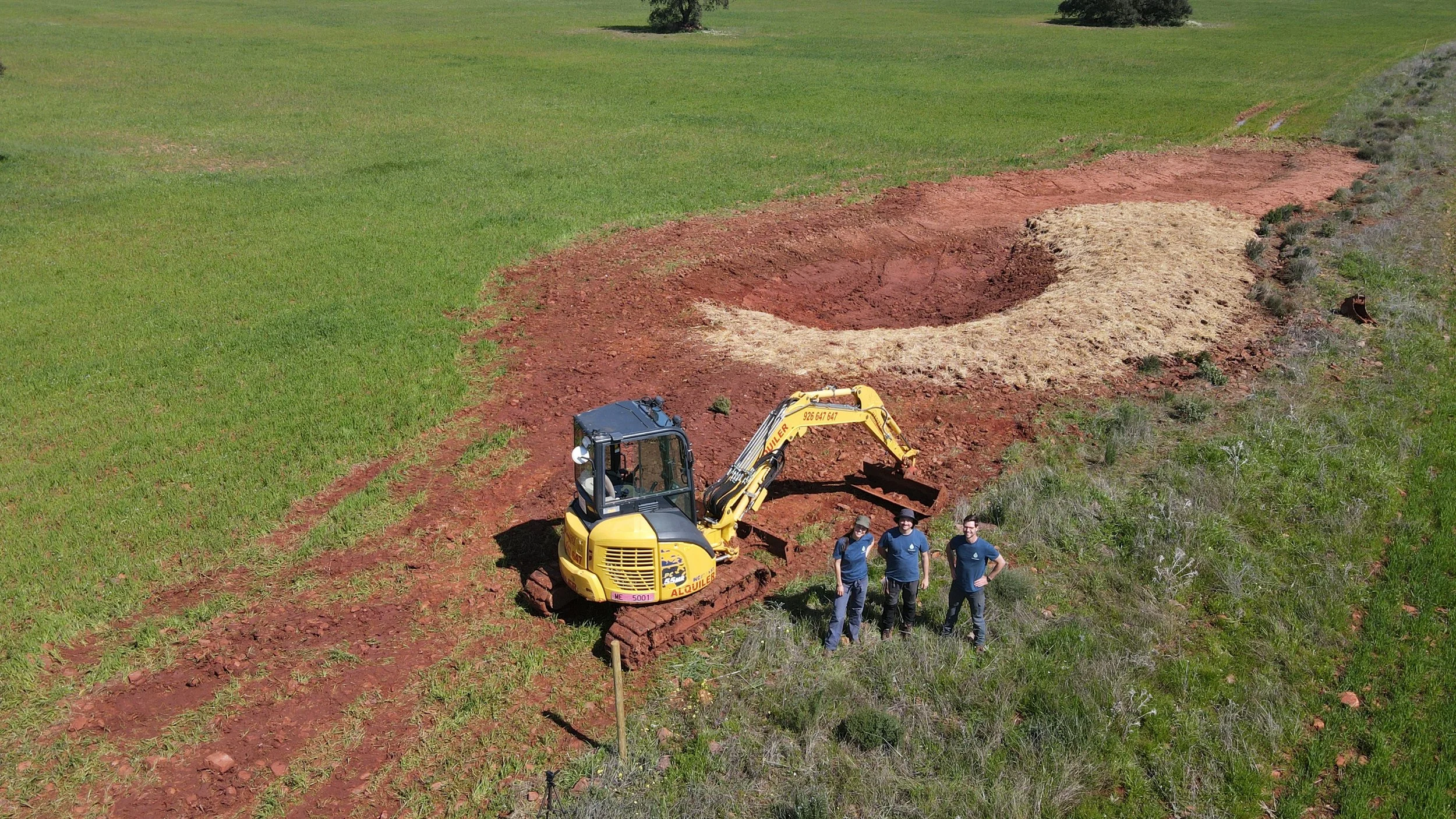
Restoring landscapes to retain water, regenerate soils and build resilience to drought, floods and wildfires
AguAbundancia is a non-profit organisation dedicated to ecosystem restoration and landscape regeneration through nature-based water management. We work to transform degraded landscapes into resilient, living and productive systems. Through practical projects, training and applied research, we aim to restore natural water cycles, regenerate soils and strengthen the relationship between people and the landscapes they depend on.
Who We Are
Our mission is to support the transformation of degraded landscapes into resilient systems by restoring water cycles, rebuilding healthy soils and strengthening local capacity.
Our vision is of landscapes capable of retaining water, regenerating biodiversity and supporting resilient communities — places where land and water are managed according to ecological principles and through collaboration between different actors.
Our multidisciplinary team brings together experience in ecological restoration, regenerative water management, soil regeneration, hydrological design and community processes.
We combine scientific, technical and practical knowledge and work with a wider network of collaborators, advisers and partner organisations. This allows us to work at different scales, from individual farms and restoration sites to wider landscape and community initiatives.
What We Do
Ecological and Hydrological Regeneration
We design and implement nature-based solutions that help landscapes capture, slow, infiltrate and retain water.
Our work includes wetland restoration, regenerative hydrological design, erosion control and ecological infrastructure that can help landscapes become more resilient to drought, flooding and wildfire.
Sponge Landscapes and Pilot Projects
We develop practical pilot projects that demonstrate how degraded areas can regain their natural capacity to absorb, store, filter and slowly release water.
These projects combine landscape interventions with soil regeneration, vegetation management and community participation.
Regenerative Hydrology Consultancy
We advise landowners, farms, organisations and public institutions on the water health of their landscapes.
We analyse how water moves through a site, identify problems and opportunities, and develop practical strategies adapted to the land and to a changing climate.
Training and Capacity Building
We provide practical and theoretical training for farmers, technicians, land managers, organisations and communities.
Our courses focus on understanding the water cycle, reading landscapes, water retention, erosion control, soil biology and regenerative hydrological design.
Who We Work With
We collaborate with people and organisations committed to restoring landscapes and improving water resilience, including:
Landowners and farms
Farmers and regenerative agriculture projects
Public administrations
Foundations and NGOs
Training and research organisations
Local communities and landscape restoration initiatives
We are particularly interested in collaborations that combine practical landscape restoration with learning, monitoring and long-term local stewardship.
Water Academy
Practical training to restore the water cycle in the landscape
The AguAbundancia Water Academy was created to help build practical skills in regenerative hydrology, water retention, erosion control and landscape restoration.
Our approach is based on learning by doing. Participants learn how landscapes store and distribute water, how soil functions as a living sponge, and how relatively simple interventions can improve resilience to drought, flooding, erosion and wildfire.
Training topics include:
Regenerative hydrology and the water cycle
Water retention and infiltration
Erosion and gully control
Restoration of springs and small catchments
Soil biology and soil regeneration
Swales and infiltration structures
Water-retention structures using natural materials
Agroforestry and water-resilient farming systems
We organise field-based workshops, generally lasting between two and five days, as well as customised training programmes for farmers, technicians, students, land managers and organisations.
We also collaborate with farms and restoration projects interested in becoming demonstration landscapes where people can learn directly from practical interventions.
Our ambition goes beyond individual sites. By restoring the relationship between soil, vegetation and water, we want to contribute to the recovery of healthier regional water cycles and more resilient Mediterranean landscapes.
Our Projects
La Nava del Conejo
Regenerative hydrological design for a Mediterranean agricultural landscape
La Nava del Conejo is an agroforestry farm in Campo de Montiel, Castilla-La Mancha, managed by FIRE as a living laboratory for agroecology and landscape restoration.
AguAbundancia's work focuses on understanding how water moves across the landscape and designing small-scale interventions that slow runoff, increase infiltration, reduce erosion and improve the resilience of rainfed agriculture.
Our work has included hydrological and topographical analysis, identifying erosion and sediment patterns, constructing infiltration ponds, harvesting water from approximately 1,200 m² of roof area, creating a rain garden and around 600 metres of infiltration channels, and adapting farm tracks so that runoff can be redirected towards agricultural land.
Further work includes erosion-control measures, restoration of a drained wetland, applications of fungal-dominated compost extracts, monitoring and training.
La Nava del Conejo is becoming a practical demonstration site where agriculture, ecological restoration and applied research come together — generating lessons that can be transferred to other Mediterranean and semi-arid landscapes.
Tajuña River Wetland Restoration
This project is located along the middle reaches of the Tajuña River, where two abandoned fish farms have degraded part of the river's natural floodplain.
Together with project partners, the aim is to transform part of this former infrastructure into a functioning wetland.
The first phase involves removing approximately 2,000 m² of concrete infrastructure, rehabilitating the soil and creating a naturalised wetland.
The project aims to:
Rehydrate the landscape and improve water infiltration
Support groundwater recharge
Restore native riparian and wetland vegetation
Improve habitat for amphibians, aquatic invertebrates, pollinators and other wildlife
Improve natural water filtration
Reduce erosion
Strengthen the landscape's capacity to regulate both floods and droughts
In the longer term, the project could expand to other abandoned ponds upstream, contributing to the gradual restoration of the Tajuña River ecological corridor.
The design phase has been completed and the project is currently awaiting the necessary administrative permissions before restoration work can begin.
Sponge Communities
Restoring the Mediterranean water cycle through landscape and community resilience
The Mediterranean is facing increasingly severe droughts, floods and wildfires. Behind many of these problems lies the degradation of the landscape's natural sponge capacity — its ability to slow, absorb, store and filter water.
Sponge Communities is an initiative developed by AguAbundancia together with Climate Farmers Academy.
Working through pilot landscapes in Spain, Portugal and France, the initiative combines ecological restoration with community capacity building.
On the landscape, this can include water-retention structures, erosion control, regenerative soil management, vegetation restoration, agroforestry, forest management and other low-impact nature-based solutions.
At the community level, we support practical training, collaborative planning, knowledge exchange and long-term local stewardship.
The central idea is simple: landscape restoration lasts when the people who live and work in a territory have the knowledge, relationships and capacity to continue caring for it.
Our current pilots aim to bring more than 30 hectares under regenerative water management, train over 100 people and develop locally owned Sponge Action Plans, while monitoring changes in water infiltration, soil health and biodiversity.
Our longer-term ambition is to help develop a network of resilient water landscapes and communities across the Mediterranean.
Mas Bilbè
Regenerating water, forests and biodiversity in the Eastern Pyrenees
Mas Bilbè is a social and ecological regeneration project near Saint-Laurent-de-Cerdans in the French Eastern Pyrenees.
The project explores how water management, forest regeneration, biodiversity, food production and human activity can be integrated within a single landscape.
Work carried out so far includes the creation of a wildlife pond, three infiltration basins, rainwater harvesting systems, a biological wetland for filtering roof water, passive irrigation for a perennial food garden and the planting of more than 1,500 trees and shrubs.
Regular compost-extract applications are also being used to encourage soil microbial activity and accelerate soil recovery.
The next phase will focus particularly on forest regeneration. Together with local forestry specialists, the project will combine selective forest management with water-retention and erosion-control measures to create healthier and more resilient woodland.
Mas Bilbè is also being developed as a place for practical training and experimentation. By monitoring changes in water, soil and forest health, we hope to understand which approaches work best and share these lessons with other landscape restoration projects.
Work With Us
We are interested in collaborating with landowners, farmers, communities, municipalities, NGOs, foundations, universities and other organisations working towards healthier and more resilient landscapes. We can support projects through:
Landscape and hydrological assessment
Regenerative water design
Nature-based water retention and erosion control
Wetland and catchment restoration
Soil regeneration
Pilot project development
Training and workshops
Monitoring and applied research
Community and multi-stakeholder processes
If you have a landscape, project or community where water resilience could become part of the solution, we would be happy to hear from you.
Contact us to explore a collaboration.